
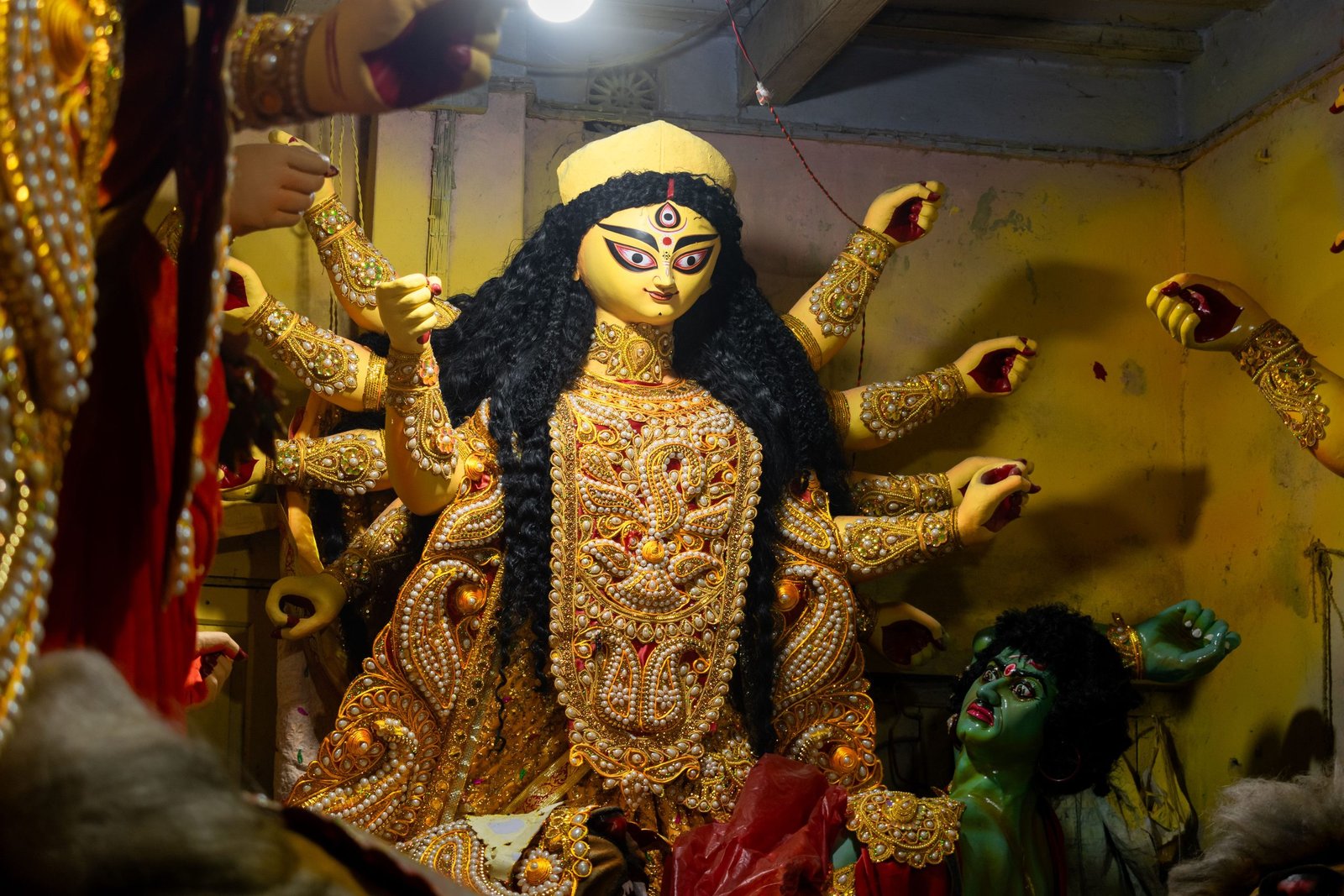
Among all the sacred seats of the goddess across India, the Kamakhya Shakti Peetha in Assam holds a place of its own. There’s no idol in the sanctum, the temple closes when the goddess is said to menstruate, and tantric practitioners have travelled there for centuries. Understanding why takes a little history and a little theology, and both are worth knowing before you visit or perform any ritual connected to the goddess.
At Maa Kamakhya Astro Centre in Rajarajeshwari Nagar, Bengaluru, devotees often ask what makes this particular Peetha different from the others. This is the short answer.
The Kamakhya Shakti Peetha and the Story of Sati
The Shakti Peethas come from the story of Sati, the consort of Shiva. After her death, a grieving Shiva carried her body across the land, and the parts of her body that fell to earth became sacred seats of the goddess. Each Peetha is associated with a particular part, and each developed its own temple, its own form of the goddess and its own ritual tradition.
Traditional lists count 51 Shakti Peethas, though the number varies between texts. The Kamakhya Shakti Peetha is counted among the oldest and most important of them, which is the first reason it carries the weight it does.
What Makes the Kamakhya Shakti Peetha Different
1. The Yoni Peetha
In the list of Peethas, Kamakhya is associated with the yoni, the womb or creative source of the goddess. This is what sets it apart from every other Peetha. Shakti is worshipped here not as a protector or a warrior but as the origin of creation itself, which gives the site its particular association with fertility, desire and renewal.
2. There Is No Idol
Walk into the inner sanctum and you won’t find a statue. The object of worship is a natural cleft in the rock, kept moist by an underground spring that flows continuously. Devotees worship the stone and the water rather than any carved image.
The sanctum is dark, reached by descending a short flight of steps, and it stays damp and close. People who have been there often describe the atmosphere as the most striking part of the visit.
3. The Goddess Is Treated as Living
Most temples treat the deity symbolically. At Kamakhya the goddess is treated as a living presence with a body and a cycle. The temple closes during Ambubachi, when the goddess is believed to menstruate, and reopens afterwards with the ritual of a new beginning. Very few places in the world build their calendar around this.
4. It Is a Centre of Tantric Practice
The Kamakhya Shakti Peetha has been a major seat of Tantra for centuries, and it remains one of the few large temples where tantric worship is openly part of the tradition rather than hidden at the margins. This is why sadhakas and practitioners from across India travel there.
5. The Ten Mahavidyas on One Hill
The complex on Nilachal Hill houses temples to all ten Mahavidyas, the ten forms of the goddess, including Kali, Tara, Tripura Sundari, Bhairavi, Chhinnamasta and Bagalamukhi. Three of them are inside the main temple and the rest have shrines of their own. Having the full set in one place is rare and is part of why the hill is treated as a complete seat of Shakti.
Where the Kamakhya Shakti Peetha Is Located
The Kamakhya Shakti Peetha sits on Nilachal Hill in Guwahati, Assam, on the banks of the Brahmaputra. The present structure was rebuilt in 1565 under the Koch king Nara Narayan, with the work supervised by his brother Chilarai, after his father Visva Singha revived worship at the ruined site. The Ahom kings later added to it and continued to patronise the temple.
The architecture is distinctive, with a beehive shaped dome and sculpted panels, and the hill gives a long view over the river. Allow time for the queue, which can be considerable on festival days.
Ambubachi Mela, Explained
Ambubachi is the most significant event in the year at the Kamakhya Shakti Peetha. It usually falls in June, during the Assamese month of Ahaar, and marks the annual menstruation of the goddess.
The temple doors close for three days. No worship is performed, and in traditional households some domestic rituals and farming activity pause as well. On the fourth day the doors reopen after purification, and devotees queue in very large numbers to receive darshan and prasad.
The exact dates shift each year with the lunar and Assamese calendar, and the temple announces them in advance. If you’re planning to travel for it, check the official announcement rather than relying on last year’s dates.
A Note on Online Pujas
This matters, so it’s worth saying plainly. The Maa Kamakhya Devalaya has publicly stated that it does not authorise any online platform to conduct pujas on its behalf. If a website offers to perform a puja at the temple in your name, treat that claim with caution and verify it directly with the temple.
Astrology centres and practitioners elsewhere in India can perform rituals and remedies in the goddess’s tradition, and many do. That is a separate thing from performing a puja inside the Kamakhya temple, and an honest practitioner will make the distinction clear rather than blur it.
Worshipping the Goddess From Elsewhere
You don’t need to be in Guwahati to follow the tradition. Devotees keep it in simple ways, with daily prayer, mantra chanting, fasting on Tuesdays or Fridays, and rituals performed through a practitioner where the horoscope calls for one.
Maa Kamakhya Astro Centre in Rajarajeshwari Nagar, Bengaluru performs Vedic and tantric rituals in this tradition under Sri Raghavendra Guruji, alongside horoscope consultations and Vastu guidance. Rituals are suggested after the chart is studied, never as a standard package.
Conclusion
The Kamakhya Shakti Peetha earns its reputation through a combination that no other site has: the yoni Peetha, a sanctum with no idol, a goddess treated as living, a long and open tantric tradition, and all ten Mahavidyas on one hill. It’s one of the oldest seats of Shakti in the subcontinent and still one of the most visited.
If you’d like to understand which form of the goddess suits your own chart, or which ritual is appropriate for you, book a consultation with Maa Kamakhya Astro Centre in Rajarajeshwari Nagar.